About Roanoke, Virginia: The Star City of the South
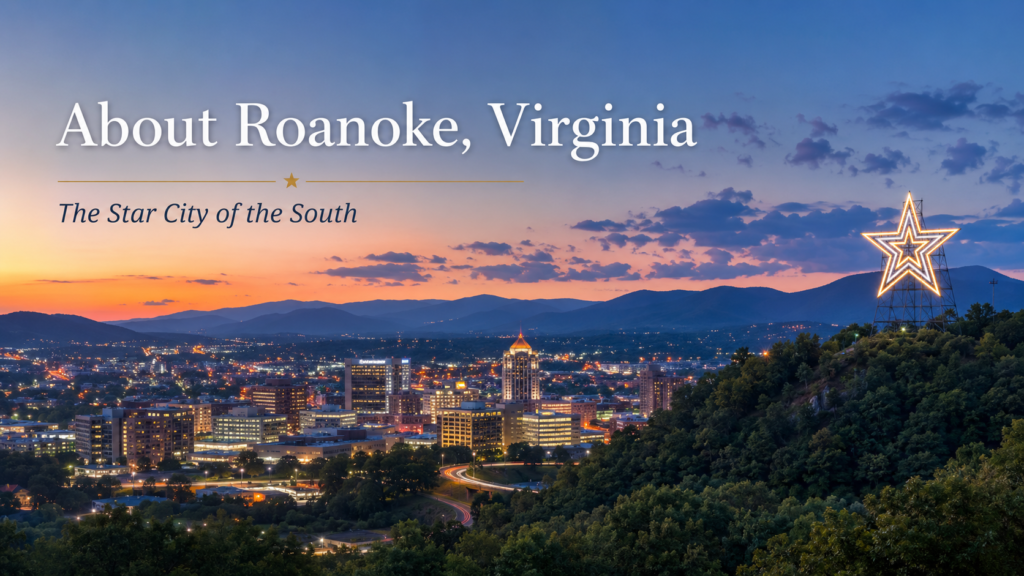
Roanoke, Virginia, is an independent city located in the heart of Virginia’s Blue Ridge Mountains in Southwest Virginia. Known as the “Star City of the South,” Roanoke combines a rich railroad history, a revitalized downtown, mountain scenery, outdoor recreation, arts, museums, local businesses and one of Virginia’s most recognizable landmarks — the Mill Mountain Star.
The city sits near Interstate 81 and the Blue Ridge Parkway, at the southern end of the Shenandoah Valley. Its location makes Roanoke a regional center for business, health care, transportation, shopping, entertainment and tourism throughout western Virginia.
Roanoke Population & City Facts
The U.S. Census Bureau estimated the City of Roanoke population at 99,111 as of July 1, 2025. The 2020 Census recorded 100,011 residents, while the 2010 Census counted 97,032.
Roanoke covers approximately 42.5 square miles of land, making it a relatively compact city surrounded by the larger Roanoke Valley and Blue Ridge Mountains.
The city is also one of the primary economic and cultural centers of western Virginia, serving residents throughout Roanoke County, Salem, Botetourt County, Franklin County and surrounding communities.
From “Big Lick” to Roanoke
Roanoke did not always have its current name.
Early communities developed in the valley during the 1800s, including Gainesborough, Old Lick and eventually Big Lick. The unusual name came from natural salt marshes, or “licks,” in the area that attracted buffalo, elk, deer and other wildlife.
The Town of Big Lick was officially chartered in 1874 with fewer than 500 residents.
Everything changed with the arrival and expansion of the railroad.
The completion of the Shenandoah Valley Railroad and its connection with what became the Norfolk & Western Railway transformed the small settlement into an important transportation center.
Big Lick became the Town of Roanoke in 1882, and just two years later, in 1884, Roanoke became a city.
Railroad employment, industry and transportation fueled rapid growth, eventually making Roanoke one of the most important railroad centers in the southeastern United States.
That railroad heritage remains a major part of the city’s identity today.
The Mill Mountain Star
Few landmarks are as closely associated with a Virginia city as the Mill Mountain Star is with Roanoke.
The giant illuminated star overlooking the city was first switched on at 8:22 p.m. on November 23, 1949 — Thanksgiving Eve.
What is now Roanoke’s most recognizable symbol was originally intended to be temporary.
The Roanoke Merchants Association sponsored the star as a Christmas-season promotion designed to encourage holiday shopping. The original plan was to dismantle it after the holidays, but residents embraced the landmark and it remained on Mill Mountain.
The star was constructed by Roy C. Kinsey and the Kinsey Sign Company, with assistance from his sons.
Rather than being a single star, the structure is actually composed of three illuminated star frames positioned inside one another.
The City of Roanoke lists some impressive statistics for the landmark:
- Approximately 88.5 feet tall
- Roughly 10,000 pounds
- Around 2,000 feet of neon tubing
- Located about 1,847 feet above sea level
- More than 1,000 feet above the city
- Original construction cost of approximately $28,000
The city has described it as the world’s largest freestanding illuminated man-made star.
Its popularity helped cement Roanoke’s longtime nickname, “The Star City of the South.”
Today, visitors can drive, hike or bike to Mill Mountain and enjoy panoramic views of downtown Roanoke, the surrounding valley and the Blue Ridge Mountains.
Mill Mountain Park
The star is only part of what makes Mill Mountain special.
Mill Mountain Park contains roughly 900 acres of parkland and includes hiking and mountain-biking trails, scenic overlooks, picnic areas, the Mill Mountain Discovery Center and Mill Mountain Zoo.
The mountain is only minutes from downtown but provides the feel of a mountain escape directly inside the city.
The combination of a downtown business district and a mountain rising immediately beside it is one of the characteristics that gives Roanoke its distinctive appearance.
Things to See & Do in Roanoke
Roanoke has developed into a destination for both outdoor recreation and arts and culture.
The Virginia Museum of Transportation celebrates the city’s railroad and transportation heritage and is particularly known for its collection of historic locomotives.
The Taubman Museum of Art, with its distinctive modern architecture, anchors part of downtown Roanoke’s arts scene and features American art, regional exhibits and rotating collections.
Center in the Square remains a major downtown cultural destination in Roanoke’s Historic Market District, bringing together museums, educational attractions, entertainment venues and community organizations.
One significant change is underway, however. The Science Museum of Western Virginia, a longtime tenant at Center in the Square, is scheduled to leave the facility when its lease expires at the end of 2026. The museum has indicated it is exploring options for a new location.
Other attractions and organizations continue to operate within and around Center in the Square, while the surrounding Historic Market District remains one of downtown Roanoke’s busiest destinations.
Nearby, Historic Roanoke City Market continues to serve as a centerpiece of downtown life, surrounded by restaurants, shops, entertainment venues and community events.
Historic Roanoke City Market
The Historic Roanoke City Market has deep roots in the city.
Records show that licenses were issued to vendors there as early as 1882, the same period when Big Lick was transforming into Roanoke.
It is widely recognized as Virginia’s oldest continuously operating market of its kind.
Today, the Market District remains one of the most recognizable areas of downtown Roanoke, combining historic architecture with restaurants, shops, apartments, events and entertainment.
Roanoke’s Railroad Legacy
Roanoke’s growth is inseparable from the railroad.
Norfolk & Western Railway operations brought thousands of workers to the region and helped transform what had been a small rural settlement into a major Virginia city.
One of the most famous pieces of that history is the Norfolk & Western Class J No. 611 steam locomotive.
The locomotive was built at the Norfolk & Western Shops in Roanoke and entered service in 1950. Today, it is the only surviving Class J locomotive and has become one of the most celebrated symbols of Roanoke’s industrial and railroad heritage.
Much of that history is preserved through the Virginia Museum of Transportation, historic rail facilities and neighborhoods throughout the city.
Outdoor Recreation
Roanoke’s location makes outdoor recreation a major part of life in the region.
Residents and visitors have access to:
- The Blue Ridge Parkway
- Mill Mountain trails
- Roanoke Valley Greenway
- Roanoke River
- Hiking and mountain biking trails
- Nearby national forests
- Appalachian Trail access
- Smith Mountain Lake
- Carvins Cove Natural Reserve
- Explore Park
Roanoke has increasingly developed a reputation as a destination where an urban downtown and extensive outdoor recreation exist within minutes of each other.
Carvins Cove
Just outside the heart of the city is Carvins Cove Reservoir and Natural Reserve, one of the region’s most important natural resources.
Carvins Cove serves as a major drinking-water reservoir for the Roanoke region while also providing thousands of acres of protected land for hiking, mountain biking, horseback riding, fishing and boating.
The surrounding reserve is among the largest municipally managed conservation areas in the United States.
Crime & Public Safety in Roanoke
Like most cities of its size, Roanoke experiences both violent and property crime, and crime levels can vary substantially from one neighborhood to another and from year to year.
Based on FBI-reported data used by crime-analysis services, Roanoke has historically experienced property and violent crime rates above some state averages.
However, recent Roanoke Police Department statistics have also shown significant declines in several categories.
During the first three months of 2026, police reported that overall crime was down approximately 23% compared with the same period in 2025, while violent crime decreased approximately 28%.
Robbery, aggravated assault, rape, burglary, larceny and motor-vehicle theft were among categories showing year-over-year decreases during that period.
Crime statistics should always be viewed in context. Population density, commercial districts, reporting practices and the locations where incidents occur can significantly affect citywide numbers.
Roanoke Today
Modern Roanoke has evolved far beyond its railroad beginnings.
Health care is now one of the region’s major economic sectors, with organizations such as Carilion Clinic playing a major role in employment, medicine, research and development.
Education, manufacturing, logistics, retail, tourism, technology, restaurants and locally owned businesses also contribute significantly to the regional economy.
Downtown Roanoke has undergone extensive redevelopment, with former warehouses and commercial buildings converted into apartments, restaurants, breweries, offices and entertainment spaces.
At the same time, the city retains numerous distinctive neighborhoods, each with its own architecture, character and history.
Popular Roanoke Attractions
Some of Roanoke’s best-known attractions and destinations include:
- Mill Mountain Star
- Mill Mountain Park
- Mill Mountain Zoo
- Virginia Museum of Transportation
- Taubman Museum of Art
- Center in the Square
- Historic Roanoke City Market
- Roanoke Pinball Museum
- Harrison Museum of African American Culture
- Blue Ridge Parkway
- Carvins Cove Natural Reserve
- Roanoke Valley Greenway
- Explore Park
- Downtown Roanoke
- Grandin Village
Roanoke Fun Facts
- Roanoke was once called Big Lick. The name came from natural salt licks in the valley that attracted wildlife.
- Big Lick had fewer than 500 residents when it was chartered in 1874.
- Big Lick became Roanoke in 1882.
- Roanoke became an official city in 1884.
- The Mill Mountain Star was originally supposed to be temporary. It began as a Christmas shopping promotion in 1949.
- The Mill Mountain Star is approximately 88.5 feet tall.
- The star weighs roughly 10,000 pounds.
- Around 2,000 feet of neon tubing are used in the landmark.
- The Roanoke Star is actually made from three separate star-shaped frames.
- Historic Roanoke City Market traces its history to 1882.
- One of America’s most famous steam locomotives was built in Roanoke. Norfolk & Western No. 611 remains the only surviving Class J locomotive.
- Roanoke has a mountain immediately beside its downtown district. Mill Mountain rises more than 1,000 feet above the city.
- The Blue Ridge Parkway passes just outside Roanoke.
- Roanoke’s population remains around 100,000 residents.
- The city covers approximately 42.5 square miles.
- Roanoke is an independent city. In Virginia, independent cities are legally separate from the counties surrounding them.
- Carvins Cove serves both as a drinking-water reservoir and a major outdoor recreation destination.
- Roanoke’s nickname, “Star City of the South,” comes from the famous Mill Mountain Star overlooking the city.
The Heart of Virginia’s Blue Ridge
From a tiny settlement called Big Lick to a booming railroad city and today’s regional center, Roanoke has undergone remarkable changes while maintaining a strong connection to its past.
The railroad helped build the city. The mountains define its landscape. Downtown reflects its continued redevelopment. And the glowing star above Mill Mountain has become a symbol recognized throughout Virginia.
Whether you live here, grew up here, are considering moving here or are simply visiting, Roanoke is a city where history, local culture, urban life and the Blue Ridge Mountains come together.